Back Office Executive Meaning (Quick Answer)
A back office executive is a company employee who handles internal administrative, data and operational work that keeps a business running, without dealing directly with customers. Typical tasks include data entry, record keeping, document verification, report preparation, billing support and coordinating with front office teams. In India, most back office executives earn roughly ₹1.8 to ₹4.5 lakh per year, depending on industry, city and experience.
What Does "Back Office" Mean?
The term comes from how older companies physically arranged their offices. Customer-facing staff such as receptionists and sales teams sat at the front, while administration and operations teams worked in the rear. Those rear teams became known as the back office.
Today the back office is no longer always a physical space behind a counter. Many companies run back office operations from separate locations, from lower-cost cities, through outsourcing partners (BPOs), or remotely. India is one of the world's largest hubs for exactly this kind of work.
The back office does not usually generate revenue directly, but it makes revenue possible. Without accurate invoices, verified documents, updated inventory and clean records, the front office cannot sell or serve customers properly.
Front Office vs Middle Office vs Back Office
Financial services firms often divide their work into three layers, and the same logic applies to most organisations.
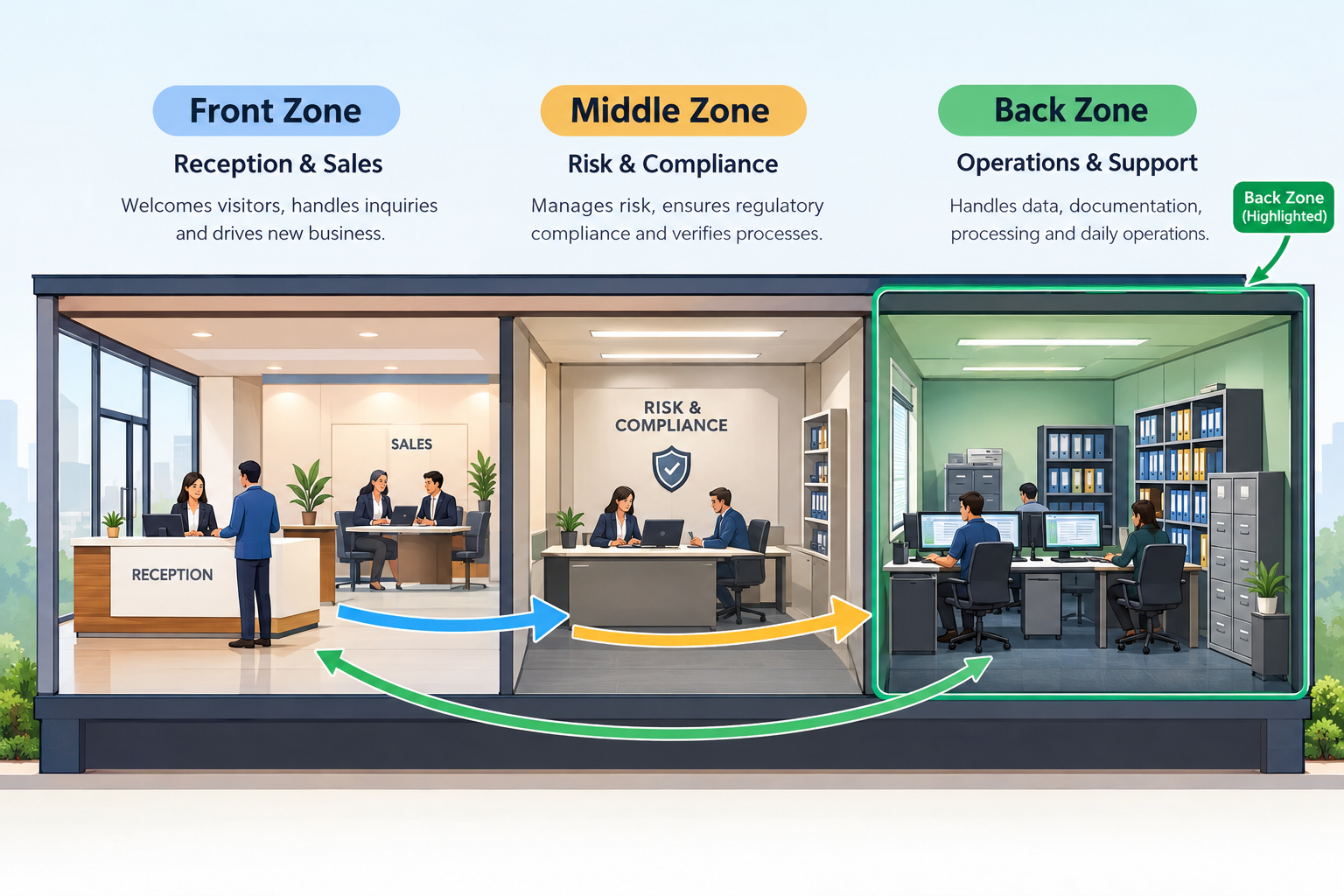
Aspect | Front Office | Middle Office | Back Office |
|---|---|---|---|
Customer contact | Direct | Limited | None or minimal |
Main purpose | Sales, marketing, customer support | Risk management, compliance, control | Administration, processing, records, IT support |
Revenue role | Generates revenue | Protects revenue | Enables revenue |
Example roles | Sales executive, relationship manager, front desk | Risk analyst, compliance officer | Back office executive, data entry operator, MIS executive |
Back office staff work closely with the front office even though they never meet the customer. For example, a salesperson may depend on the back office for accurate stock levels and prices before confirming an order.
Back Office Executive Roles and Responsibilities
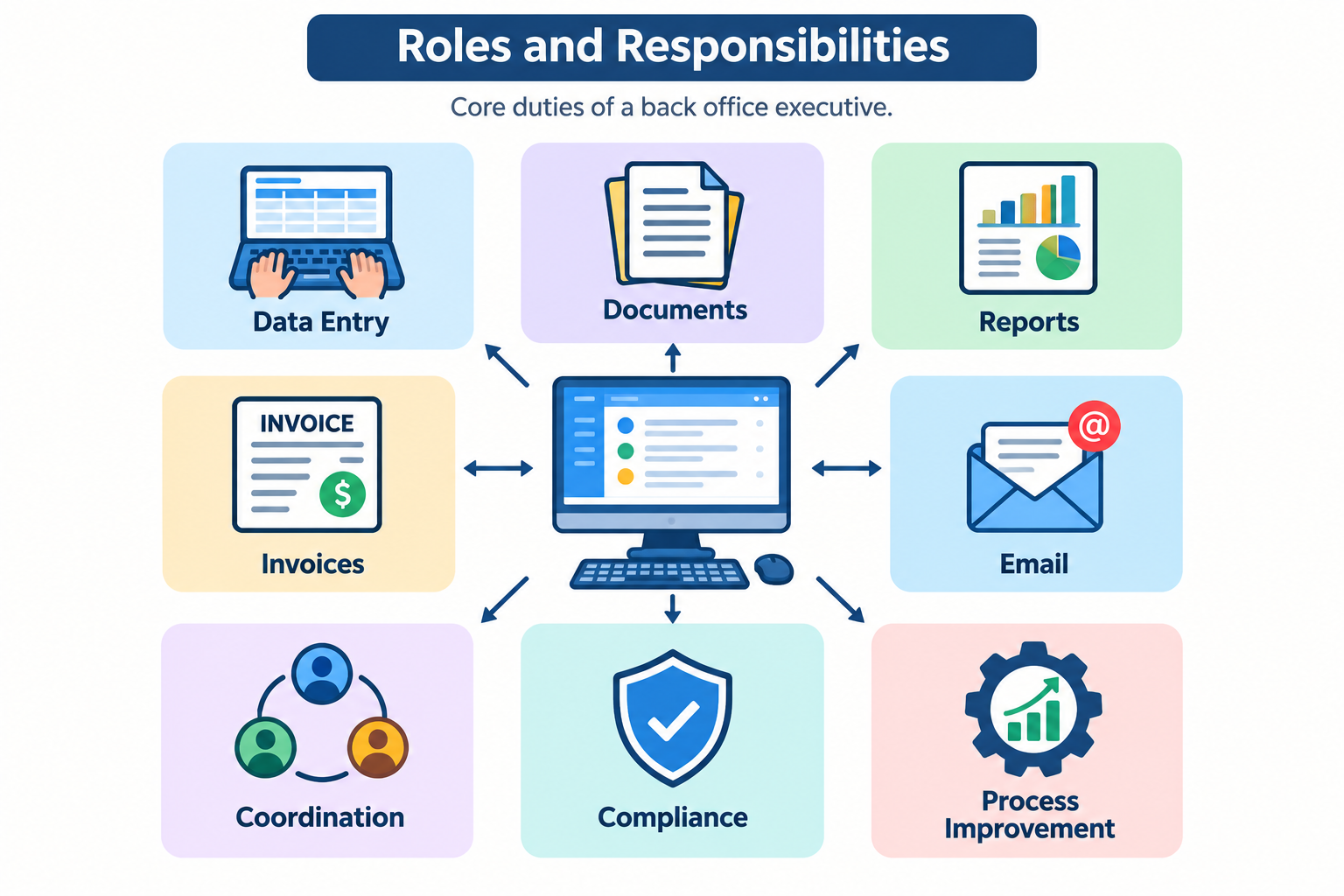
Exact duties depend on company size and industry, but most job descriptions include the following.
Core responsibilities
Data entry and management: Entering, updating and verifying information in software such as Excel, ERP or CRM systems.
Documentation and record keeping: Maintaining physical and digital files, checking documents for accuracy and completeness.
Reporting and MIS: Preparing daily, weekly and monthly reports for managers.
Transaction processing: Supporting billing, invoicing, payments, settlements or order processing.
Coordination: Working with sales, accounts, HR, logistics and customer support teams to resolve queries.
Administrative support: Handling emails, scheduling, meeting minutes and internal communication.
Compliance and confidentiality: Following company policies and protecting sensitive employee or customer data.
Process improvement: Flagging errors and suggesting faster ways to complete recurring tasks.
Back office executives usually report to a Back Office Manager, Operations Manager or Department Head.
Back office executive role by industry
Industry | Typical back office work |
|---|---|
Banking and finance | Account processing, KYC verification, loan documentation, settlements |
BPO and KPO | Process-based tasks such as claims, order handling and data validation |
Healthcare | Patient records, appointment scheduling support, medical billing coordination |
E-commerce and logistics | Order tracking, inventory updates, seller or vendor documentation |
Aviation and hospitality | Ticketing support, reservations records, vendor billing |
Manufacturing and retail | Purchase orders, stock registers, dispatch records |
A Typical Day in the Life
A back office executive's day often starts by checking emails and pending tasks. The morning goes to data entry and verification, followed by updating trackers and answering internal queries from sales or accounts teams. Afternoons are usually for report preparation, document filing and handing over the day's MIS summary to the manager. Deadlines such as month-end closing can make some days much busier.
Skills Required for a Back Office Executive
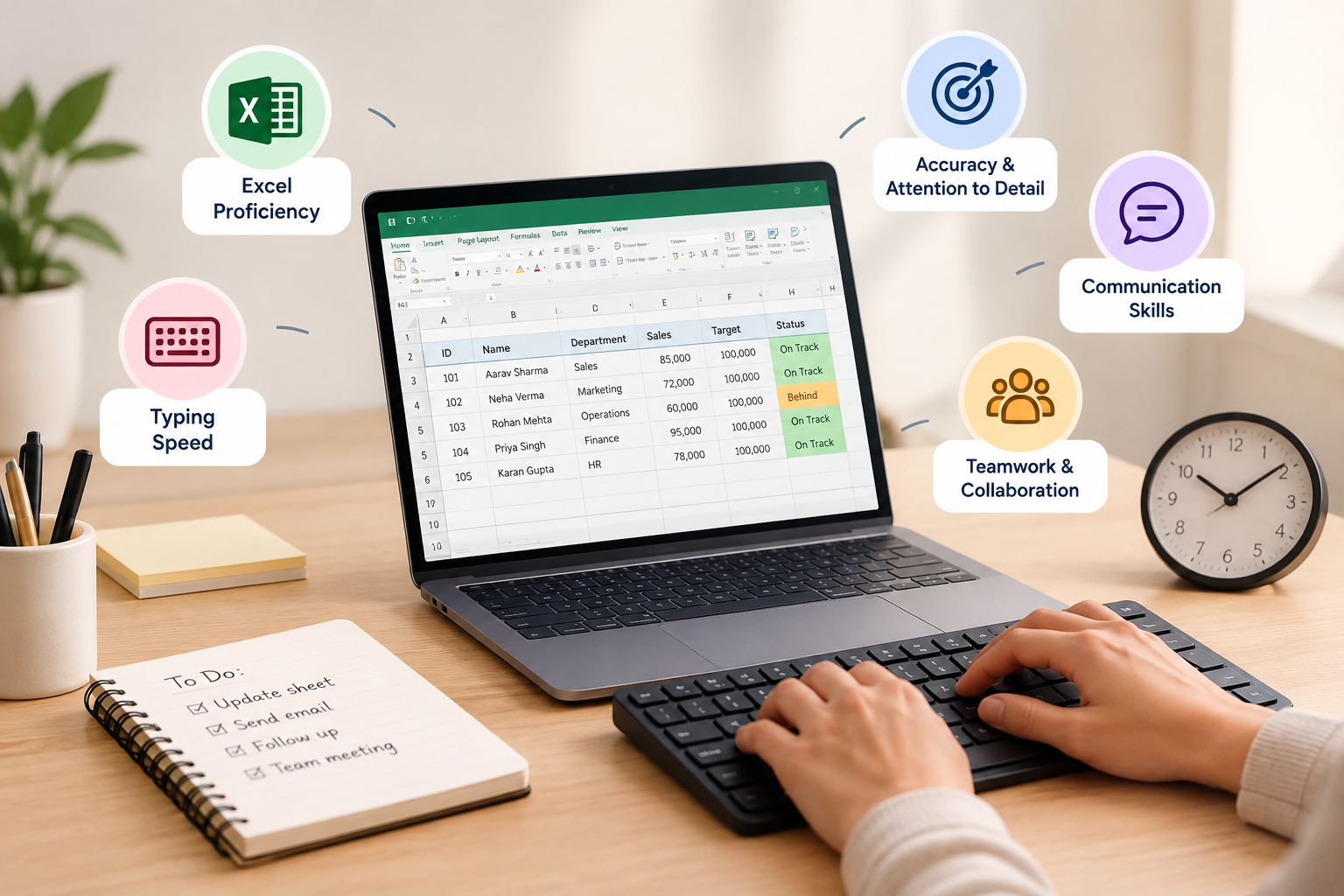
Skill type | Skills |
|---|---|
Technical | MS Excel (VLOOKUP, pivot tables), MS Word, Outlook, typing speed and accuracy, ERP or CRM familiarity, basic accounting knowledge |
Analytical | Data validation, error detection, report preparation, basic MIS |
Soft | Attention to detail, time management, written and verbal communication, teamwork, adaptability, confidentiality |
Growth skills | Power BI or Google Sheets automation, basic SQL, process documentation, Tally or GST basics for finance-heavy roles |
Organisation and adaptability consistently appear among the top skills employers look for, because back office processes change as tools and company needs change.
Eligibility and Qualification
Education: A bachelor's degree in any stream such as B.Com, BBA, BA or BSc is commonly asked for. Some employers also consider 12th-pass candidates for entry-level openings.
Certifications that help: MS Office or advanced Excel, data entry or typing certification, office administration, and Tally for accounting-related roles.
Experience: Freshers are widely hired; many postings ask for 0 to 2 years of experience.
Back Office Executive Salary in India (2026)
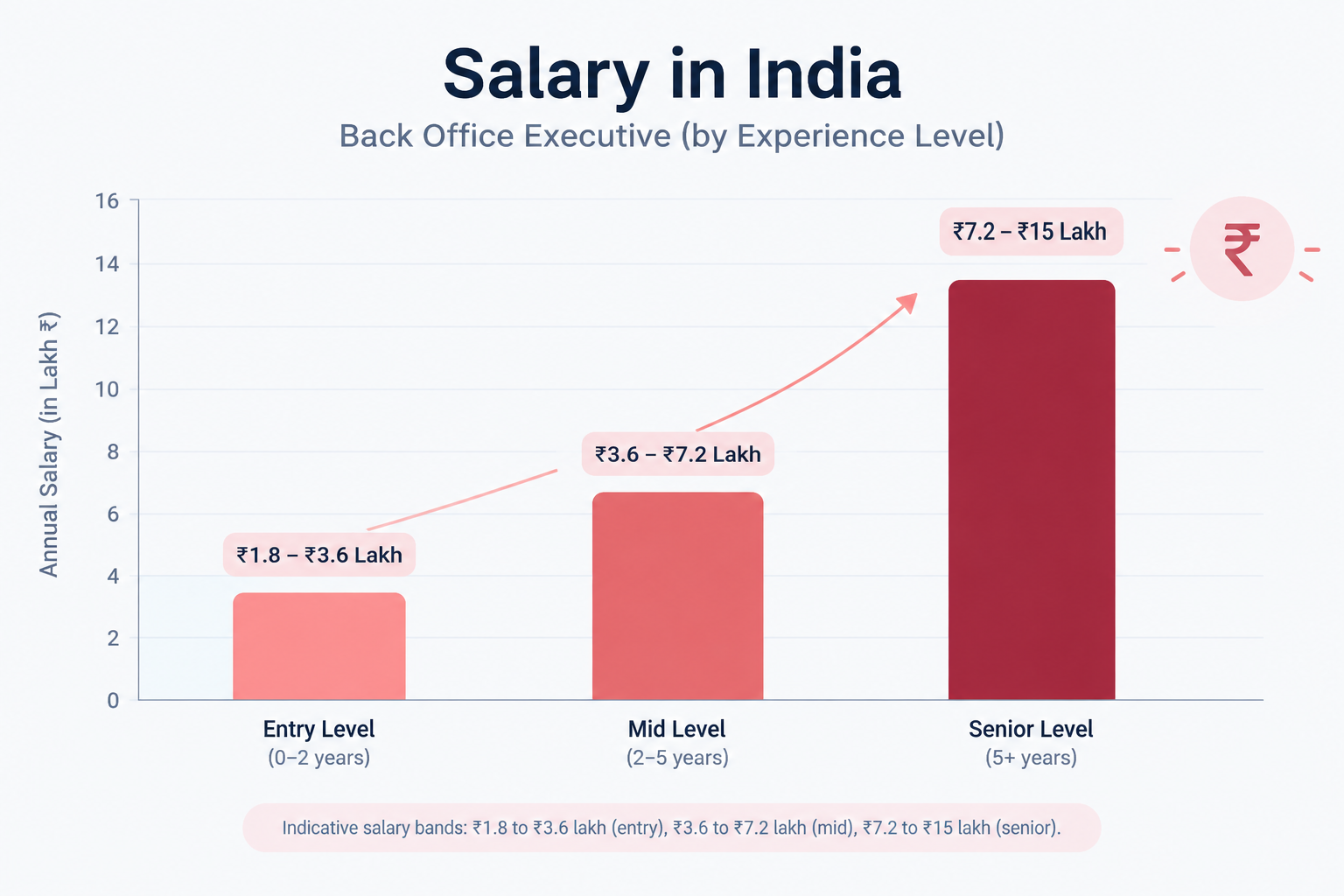
Salaries vary a lot by employer, industry and city. The figures below are drawn from publicly available salary platforms and should be treated as indicative ranges, not guarantees.
Source or employer | Reported annual range |
|---|---|
DocThub (general India range) | ₹1.8 to ₹4.5 lakh |
Jooble (job-posting average, July 2026) | About ₹3.6 lakh (₹30,100 per month) |
Flipkart (AmbitionBox) | ₹1.4 to ₹4.5 lakh |
Sodexo (AmbitionBox) | ₹1.8 to ₹3 lakh |
BT Business (AmbitionBox) | ₹3.2 to ₹4 lakh |
Air India (AmbitionBox) | ₹2.2 to ₹5.4 lakh |
Air India SATS (AmbitionBox) | ₹1.7 to ₹2.2 lakh |
By experience level (a broader back office and secretarial support estimate from CorpReady, which blends several platforms):
Experience | Estimated annual salary |
|---|---|
Entry (0 to 2 years) | ₹1.8 to ₹3.6 lakh |
Mid (3 to 7 years) | ₹3.6 to ₹7.2 lakh |
Senior (8+ years) | ₹7.2 to ₹15 lakh |
Take-home pay is lower than the annual figure after PF and deductions. For example, AmbitionBox estimates monthly take-home at about ₹18,500 to ₹20,200 at Tech Mahindra and about ₹19,200 to ₹20,800 at Flipkart.
What increases your salary:
Industry: Banking, IT services, e-commerce and multinational operations generally pay more than small local firms.
City: Metro cities such as Mumbai, Bengaluru, Delhi NCR, Pune and Hyderabad usually pay more than tier-2 cities.
Skills: Advanced Excel, MIS, SQL and Power BI move you toward analyst-type pay.
Shift and domain knowledge: Night shifts, international processes and finance or compliance knowledge often add to pay.
Career Scope and Growth Path
Back office work is a common entry point into corporate operations, especially for freshers.
Typical progression:
Back Office Executive (entry)
Senior Back Office Executive
Team Leader or Process Lead
Assistant Manager, Operations
Operations Manager or Department Head
Lateral and upward options:
MIS Executive or Data Analyst
Operations Executive
Billing or Accounts Executive
Administration Executive or Office Manager
HR operations or payroll
Moving into front office, sales or client-facing roles
The back office is also a recognised stepping stone into front office roles, particularly in finance, though how quickly you move depends on your performance, skills and company.
Is Back Office Executive a Good Career?
Advantages
Low entry barrier and strong demand across industries
Regular hours in many companies and no customer pressure
Good foundation in business operations, data and processes
Clear route into operations, MIS and analytics
Disadvantages
Entry-level pay can be modest
Work can be repetitive
Routine tasks are exposed to automation
Growth can be slow without upskilling
Verdict: It is a good starting career if you treat it as a launchpad. It is a weaker long-term choice if you only do data entry and never build analytical or process skills.
How AI and Automation Affect Back Office Jobs
AI and robotic process automation are taking over rule-based tasks such as bulk data entry and simple document matching. Salary research platforms already describe this occupation group as being disrupted by AI. At the same time, companies still need people who can check exceptions, handle judgement-based issues, manage vendors and interpret reports.
How to stay relevant:
Learn advanced Excel, Power Query and dashboards
Pick up basic SQL and Power BI
Understand end-to-end processes rather than a single task
Build communication and problem-solving skills
Learn to use AI tools to speed up reporting and documentation
How to Become a Back Office Executive: Step by Step
Complete graduation in any stream, with commerce or business being an advantage.
Learn the tools: MS Excel, Word, email and typing with accuracy.
Add a certification in advanced Excel, data entry or office administration.
Build a simple resume highlighting tools, typing speed and any internship or project work.
Apply on job portals such as Naukri, Indeed, LinkedIn and company career pages, and to BPOs, banks and e-commerce firms.
Prepare for the interview and test: expect a typing test, Excel questions and basic aptitude.
Upskill after joining to move into MIS, analytics or team lead roles.
Similar Job Titles to Know
Back Office Executive, Back Office Staff, Back Office Associate, Data Entry Operator, MIS Executive, Operations Executive, Administration Executive, Office Coordinator and Billing Executive. Titles overlap, so always read the job description before applying.
Conclusion
A back office executive keeps the unseen machinery of a company working: accurate data, verified documents, timely reports and smooth coordination between teams. The role offers an accessible entry into the corporate world, steady demand across banking, BPO, e-commerce, healthcare and logistics, and a clear path into operations and analytics for those who keep building skills. If you are considering this career, start with strong Excel and communication skills, then aim to understand the whole process, not just one task.
Did you find this useful?
Comments (0)
You must be logged in to leave a comment.
Log In to Comment