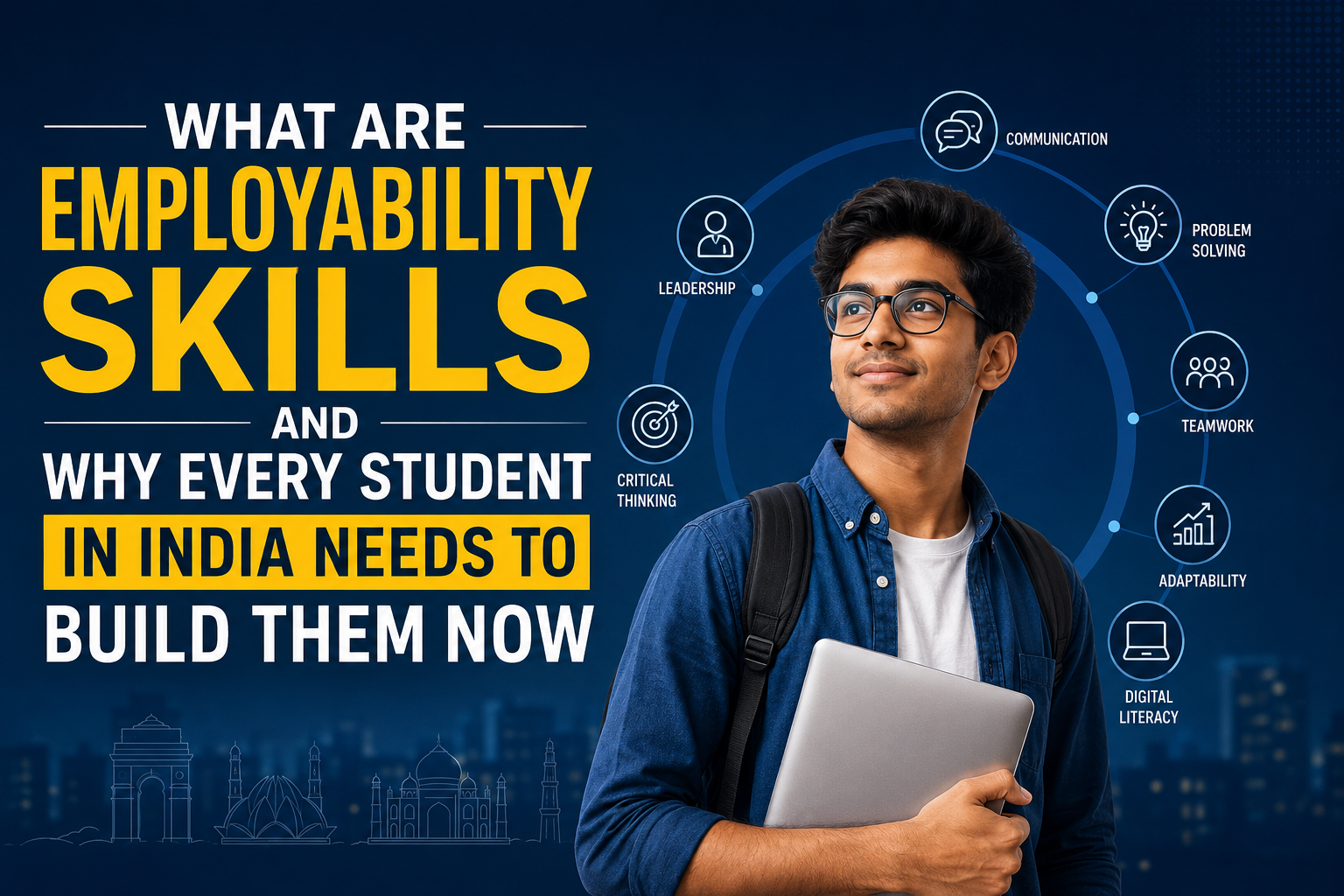
India produces millions of graduates every year but the India Skills Report 2026 shows that only 56.35 percent of them are considered job-ready by employers, which means nearly one in two students completes a degree and still cannot get hired for a role that matches their qualification.
The problem is not always intelligence or academic performance but the absence of employability skills that employers use to judge whether a candidate can actually do the job rather than just describe how it should be done. Employability skills are the combination of technical competence, practical ability and workplace-ready behaviour that turn a qualified graduate into someone a company is confident hiring.
This blog covers what employability skills are, why each one matters in the 2026 job market and how students can build them deliberately during their academic program rather than scrambling to develop them after graduation.
What Employability Skills Actually Mean in the Context of India's Job Market
Employability skills are not just a list of things to write on a resume. Here is what they actually mean in the context of how Indian companies hire in 2026:
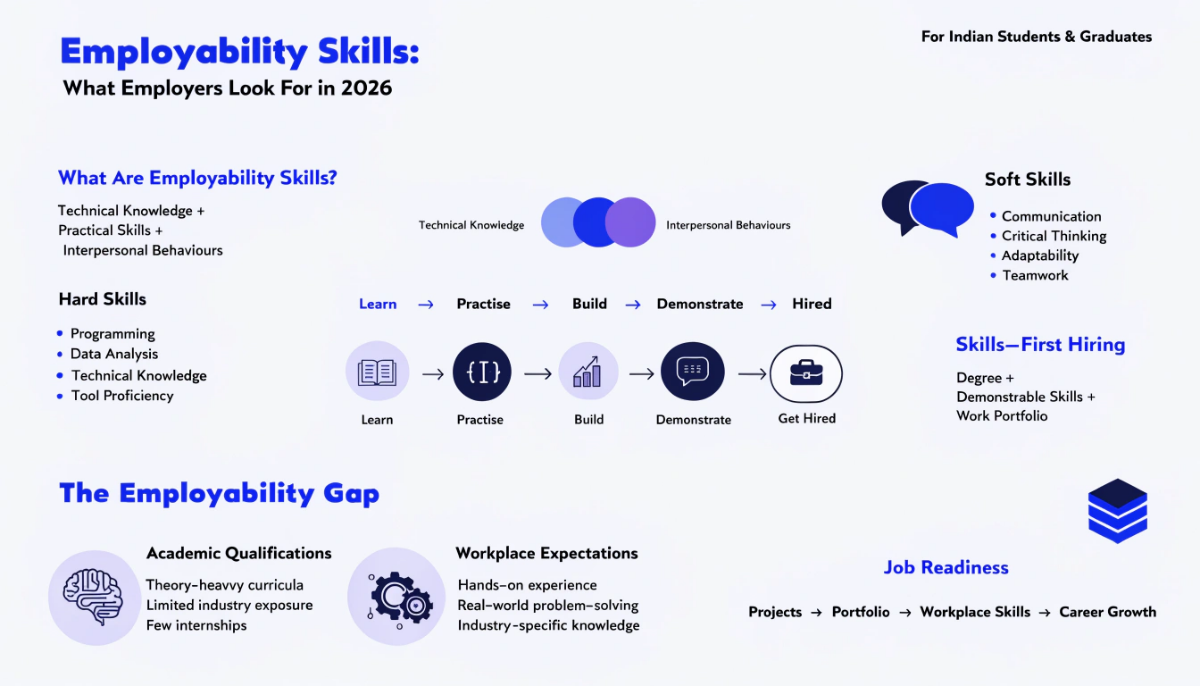
Employability skills refer to the combination of technical knowledge, practical capabilities and interpersonal behaviours that allow a person to get a job, perform well in it and grow within a profession over time, which is different from academic skills that primarily demonstrate the ability to learn and pass assessments
The India Decoding Jobs 2026 Report found that only around 55 percent of graduates are considered employable, and the Unstop Talent Report 2026 found that 85 percent of engineering graduates and 74 percent of business school students remain unplaced despite strong hiring intent from companies, confirming that the employability gap is structural rather than a reflection of limited job availability
Indian employers have shifted away from degree-based screening towards skills-first recruitment according to the TeamLease EdTech Career Outlook Report for HY1 2026, which means a degree from a recognised institution is no longer sufficient on its own and needs to be backed by demonstrable employability skills to convert to a job offer
80 percent of employers now value portfolios of work among the top indicators of job readiness according to the NIIT India Skills Gap Report 2026, which represents a fundamental change from credential-based hiring where the degree alone determined shortlisting
Employability skills cover both hard skills such as technical domain knowledge, data analysis, programming and tool proficiency and soft skills such as communication, critical thinking, adaptability and teamwork, and employers in 2026 consistently say they want both in the same person rather than trading one off against the other
Computer Science and IT graduates hold the highest employability rate at 80 percent in 2026 driven specifically by AI, data analytics and automation-related roles, while MBA graduates' employability has dropped from 78 to 72.76 percent indicating a clear market preference for applied cross-domain expertise over general management theory
Understanding what employability skills are is the starting point, but the action that matters is building them deliberately during your program, and the students who close the employability gap while studying are significantly better positioned than those who plan to develop workplace skills after they get a job
Technical Employability Skills That Determine Whether You Get Shortlisted
Technical skills are the first filter in any hiring process and in 2026 the bar has shifted. Here is what the current technical employability skills landscape looks like for Indian students:
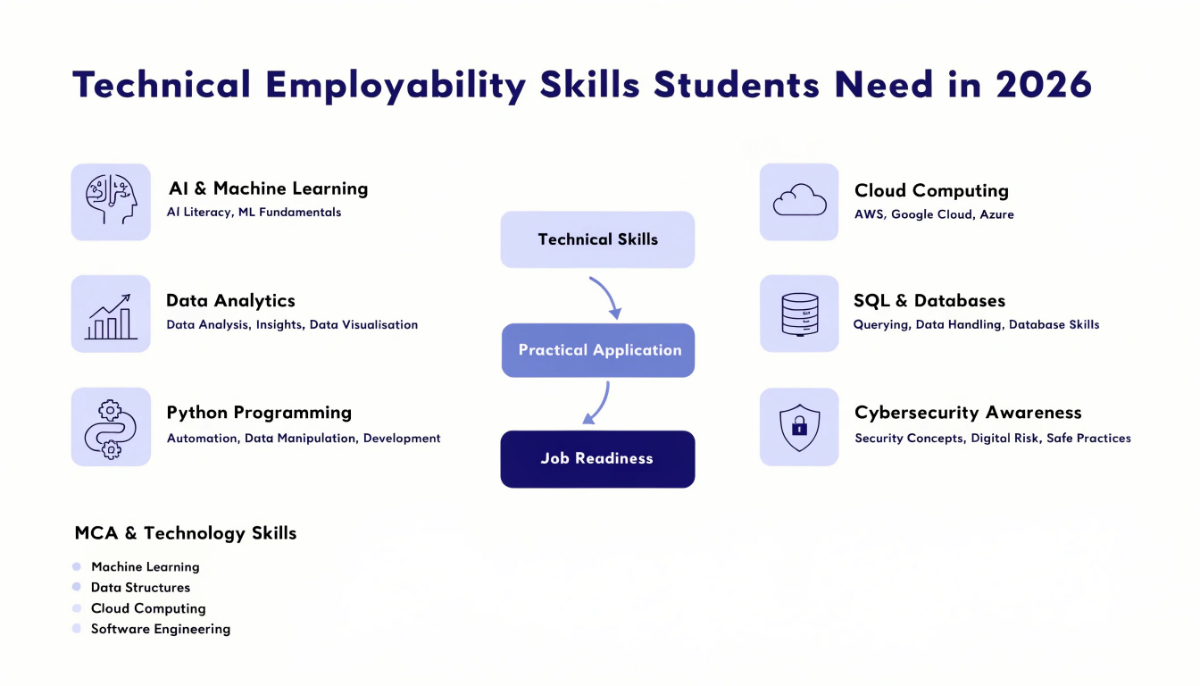
AI and machine learning literacy is the single most in-demand technical skill across India's hiring market in 2026, with AI and ML engineer roles showing 600 percent job growth according to the India Skills Report 2026, which means any student in a technology or management program who does not build at least foundational AI familiarity is entering the job market with a significant gap
Data analytics skills covering the ability to work with structured data, run basic analyses and present data-driven insights are now expected at entry level in IT, BFSI, FMCG, healthcare and consulting roles rather than being a specialist capability, and students who cannot demonstrate data literacy in a technical assessment are being screened out before interviews begin
Python programming has become a baseline technical employability skill across both technology and business roles in India, with the IT sector leading fresher hiring at 35 percent in 2026 and the majority of those roles requiring at least working Python proficiency for data manipulation, automation and application development tasks
Cloud computing familiarity across at least one major platform such as AWS, Google Cloud or Azure is an increasingly standard technical requirement at technology and analytics roles, and certifications from these platforms are among the most employer-recognised credentials a student can add to their technical employability skills profile within three months
SQL and database querying ability is required at almost every data-adjacent role and is consistently among the most tested technical skills in first-round assessments at companies across BFSI, e-commerce, logistics and technology, making it one of the most important technical employability skills for any student who wants to work in a role that involves any form of data handling
Cybersecurity awareness has grown from a specialist technical skill to a general employability requirement across IT and technology roles as organisations face increasing digital risk, and even non-specialist roles at technology companies now expect candidates to demonstrate basic understanding of security concepts and practices
For students pursuing an MCA or technology-aligned program, the technical employability skills developed through the curriculum including machine learning, data structures, cloud computing and software engineering directly map to the skills identified by NASSCOM as having a 60 to 73 percent demand-supply gap in India's current talent market
Communication and Interpersonal Employability Skills That Employers Cannot Find
The most commonly cited employability gap in 2026 is not technical but human. Here is what communication and interpersonal employability skills look like in a hiring context:
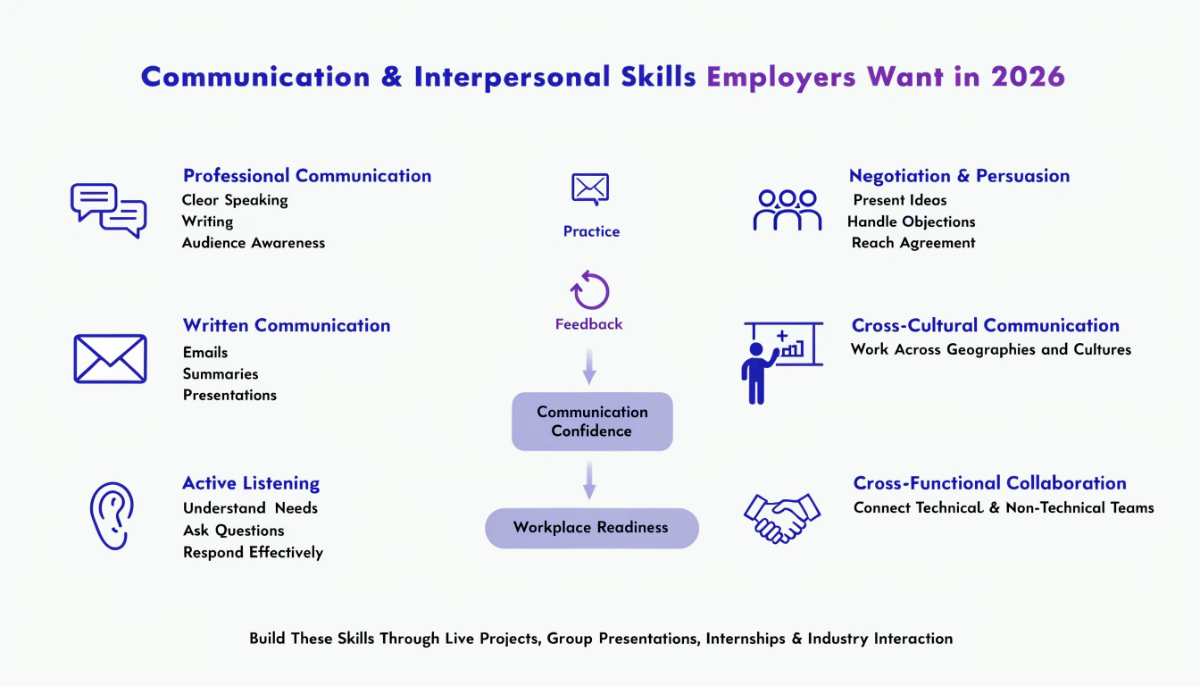
Professional communication, the ability to express ideas clearly in writing and speaking to different audiences including peers, managers and clients, is cited as a missing employability skill in fresh graduates at companies across every industry in India and is the single most consistent complaint from Deloitte and KPMG hiring managers about campus recruits
Deloitte India directors have specifically argued that the country's job market wants technical fluency and human ability in the same person, with AI increasingly able to write code, analyse data and draft reports but unable to read a room, build trust with a client or steer a team through a difficult project, which makes interpersonal employability skills a permanent human advantage
Structured written communication including the ability to write a clear email that drives action, produce a concise summary of a complex situation or build a presentation that a non-specialist audience can follow is a daily requirement at every professional role and one that most students have not practised in a professional context before their first job
Active listening and the ability to understand what a client, colleague or manager actually needs rather than what they literally said is a communication employability skill that develops through live project work, group discussions and mentored practice rather than classroom instruction, which is why programs that include these elements consistently produce better-communicating graduates
Negotiation and persuasion skills that allow a professional to present a point of view, handle objections and reach an agreement without conflict are directly applicable in sales, consulting, procurement and management roles and are among the interpersonal employability skills that most campus programs do not develop through their standard academic activities
Cross-cultural and cross-functional communication matters increasingly in 2026 as companies operate across geographies and require employees who can translate between technical and non-technical teams, which is the kind of interpersonal employability skill that develops specifically in environments where students work on real problems with mixed-domain peers
Students who want to build communication employability skills during their program should prioritise live project work, group presentations, internship exposure and industry interaction over passive learning formats, since communication is a practice skill that deteriorates without use and improves rapidly with structured, feedback-rich practice
Critical Thinking and Problem-Solving: The Employability Skills Every Role Requires
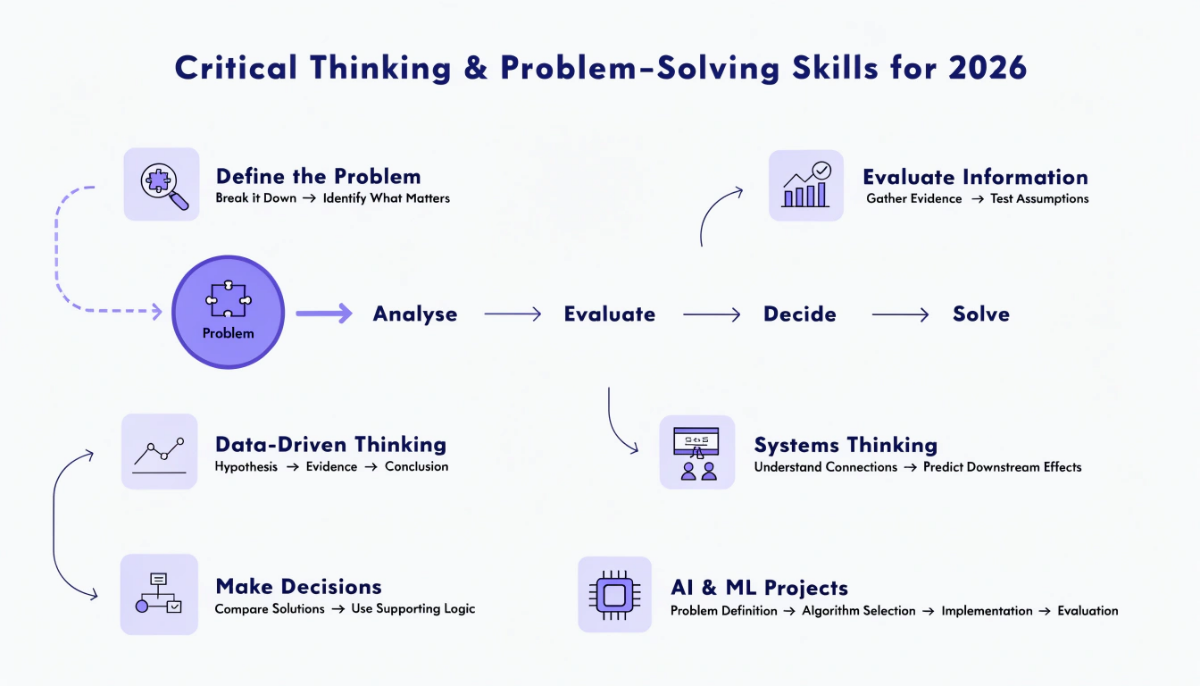
Critical thinking is the employability skill that matters in every role regardless of domain and it is one of the most consistently cited gaps between what employers expect and what they find in fresh candidates. Here is the specific picture:
Critical thinking as an employability skill means the ability to look at a problem without a template, break it into its component parts, identify what information is needed, evaluate possible solutions against clear criteria and recommend a course of action with supporting logic, which is different from the ability to apply a learned formula to a known problem
Problem-solving employability skills are tested directly in case interviews at consulting firms, analytical thinking assessments at BFSI companies and product reasoning discussions at technology companies, which means the ability to think structurally under pressure is not just a valued quality but an assessed competency that determines whether you advance past the first interview round
Employers across India's top hiring sectors consistently cite the inability to approach an unfamiliar problem without guidance as the most frustrating gap they encounter in fresh graduate hires, since the job involves encountering new situations daily and a candidate who freezes when they do not recognise the problem type is a liability at any seniority level
Critical thinking employability skills improve fastest through exposure to real business problems in case-study format, through internship roles where the work is unstructured rather than task-assigned, and through hackathons and project competitions where teams have to define the problem before they can solve it
Data-driven decision making, the habit of forming a hypothesis, testing it against available evidence and updating the conclusion based on what the data shows rather than what intuition suggests, is a specific form of critical thinking employability skill that is particularly valued at analytics, product and consulting roles in 2026
Systems thinking, the ability to understand how individual components of a business, process or product interact with each other and anticipate the downstream effects of a change, is the advanced layer of critical thinking employability skills that separates entry level analysts from mid-level managers, and students who develop this perspective during their academic program arrive in the workplace significantly ahead of their peers
MCA programs with a specialisation in AI and Machine Learning build critical thinking through computational problem-solving, algorithm design and project-based assessments that require students to define the problem, select the approach, implement the solution and evaluate the result, which is the full cycle of problem-solving that employers are looking for and which most purely theory-based courses do not develop
Adaptability and Digital Literacy: The Employability Skills Defining the 2026 Workplace
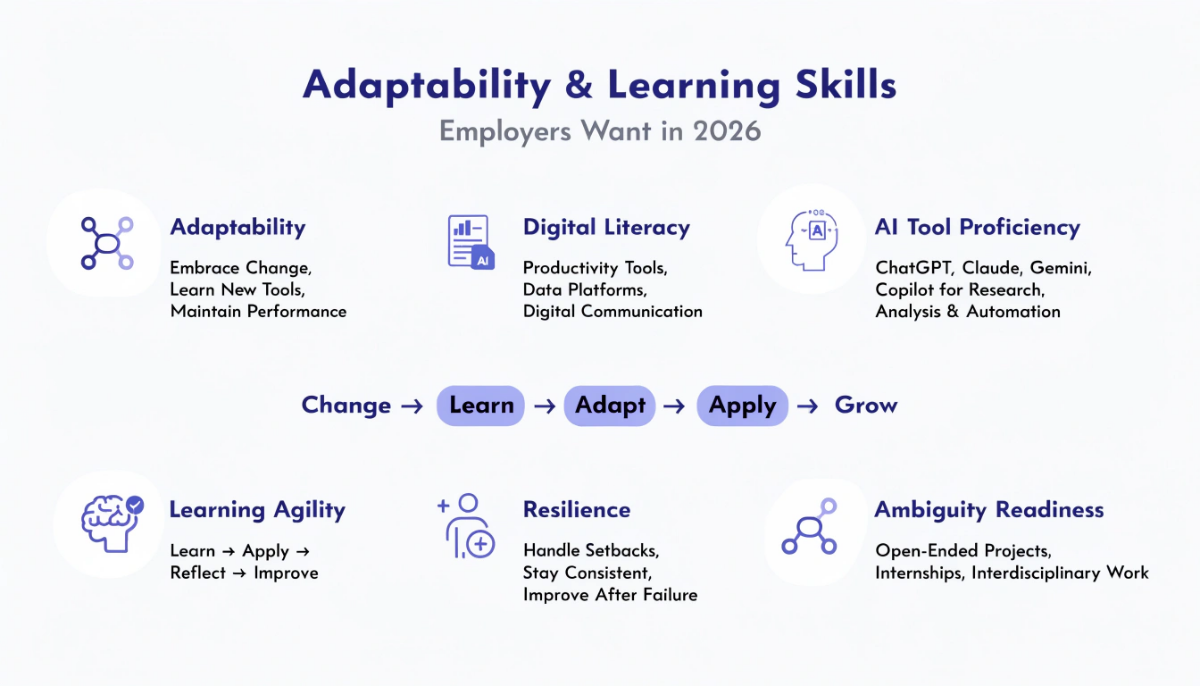
The 2026 job market rewards adaptability more than stability because the pace of change in every sector has made the ability to learn new things quickly more valuable than deep expertise in a fixed set of tools. Here is what this means for employability skills:
Adaptability as an employability skill means the willingness to change how you work when the context changes, to pick up a new tool or process without significant resistance and to maintain performance quality during transitions that disrupt the familiar workflow, which is a behaviour that employers directly assess through interview questions about past experiences and directly observe during probation periods
Digital literacy, the ability to use digital tools effectively and learn new ones with minimal guidance, is now a foundational employability skill rather than a specialist technical competency, and candidates who are comfortable with productivity platforms, data tools, communication software and AI-assisted workflows are significantly more valuable to employers than those who need extensive onboarding for standard digital tasks
India's gig workforce is projected to reach 23.5 million by 2030 and gig hiring grew 38 percent in 2025 alone, which means adaptability and the ability to perform independently in fluid, project-based work environments without the structure of a traditional employment relationship is an increasingly relevant employability skill even for students who plan to work in conventional corporate roles
AI tool proficiency, specifically the ability to use generative AI tools like Claude, ChatGPT, Gemini and Copilot productively in a professional workflow for drafting, analysis, research and automation, is one of the new foundational digital employability skills in 2026 and was cited by 23 percent of employers in the GMAC 2026 survey as the most noticeable gap in recent hires
Learning agility, the speed at which a person can acquire a new skill, apply it, reflect on the outcome and adjust their approach, is the meta-employability skill that determines how quickly every other skill on this list can be developed, and employers increasingly use early tenure performance reviews specifically to assess whether a new hire is learning at the expected pace rather than waiting for a formal probation evaluation
Resilience in the face of setbacks, the ability to maintain effort and professional quality after a failed project, a missed target or a difficult performance review, is an adaptability-related employability skill that separates the candidates who become reliable long-term employees from those who disengage when the work gets hard
Students who are most adaptable in the workplace tend to be those who have faced ambiguity during their academic program, whether through open-ended projects, interdisciplinary coursework or internship roles where their tasks were not fully defined at the start, which is why programs that build these experiences into their curriculum produce more adaptable graduates than those that deliver fully structured, exam-oriented learning throughout
Teamwork and Leadership Employability Skills That Get You Promoted
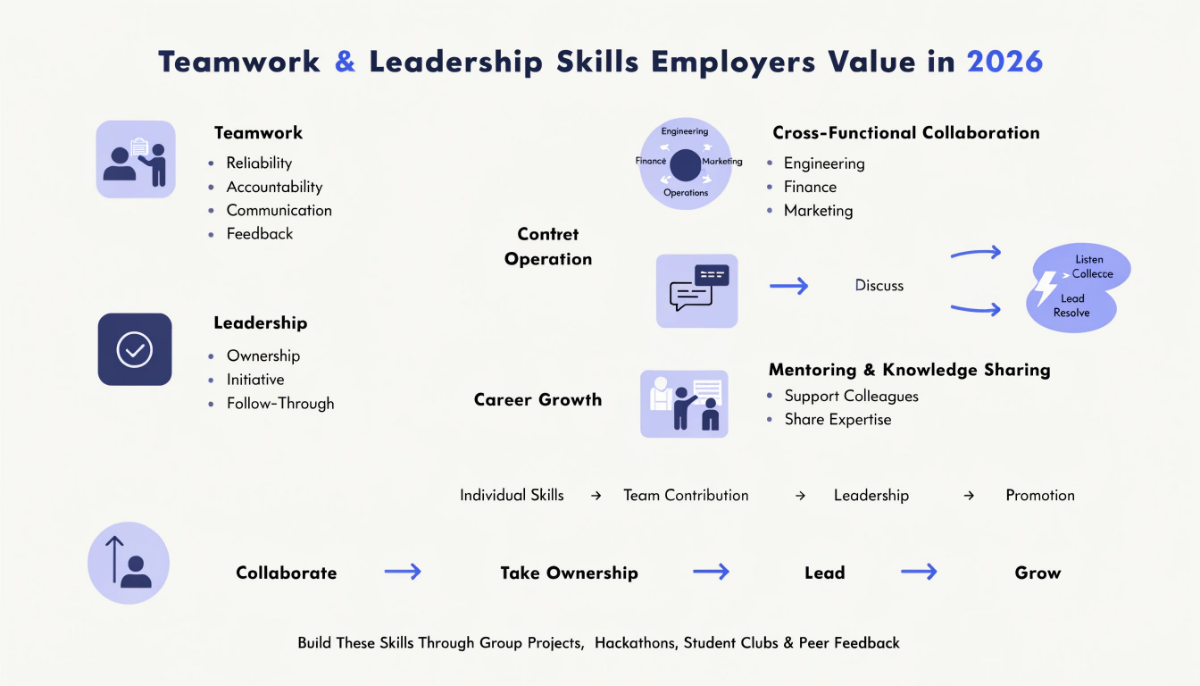
Getting hired requires individual employability skills but getting promoted requires team and leadership skills. Here is what these look like in 2026:
Teamwork as an employability skill means being a reliable, communicative and accountable member of a group working toward a shared goal, which involves contributing your assigned work on time, flagging problems early rather than hiding them and giving and receiving honest feedback without taking it personally
Leadership employability skills at the entry level do not mean managing a team but mean taking ownership of a piece of work, initiating a solution without being asked and following through to completion without needing continuous supervision, which is the behaviour that managers consistently identify as the strongest predictor of promotion readiness in the first 12 to 18 months of employment
Collaboration across different functions, the ability to work effectively with people from engineering, finance, marketing and operations on a shared project without defaulting to your own domain's perspective, is an employability skill that is specifically valued at organisations with cross-functional team structures, which includes virtually every company above a certain size in 2026
Conflict resolution, knowing how to navigate a disagreement within a team professionally and constructively without escalating it to management or damaging the working relationship, is an employability skill that most students have not had to use in an academic setting but encounter regularly in their first year of employment
Mentoring and knowledge sharing, the willingness to help a colleague understand something you know well, is a leadership employability skill that builds your reputation within a team faster than almost any other behaviour and is particularly valued at organisations that use 360-degree feedback in performance reviews
Women's employability in India rose sharply to 54 percent in 2026, overtaking men at 51.5 percent for the first time in five years, which reflects the growing recognition that communication, empathy and collaborative leadership, skills in which women consistently score higher on structured assessments, are among the most valued employability skills across India's top hiring sectors
Students who want to develop teamwork and leadership employability skills during their program should actively seek out group projects, take on coordinator or lead roles within student clubs or hackathon teams and ask for feedback on their collaboration style from peers and mentors rather than waiting for an employer to surface this information during a performance review
Conclusion
Employability skills in 2026 are not extras you develop after you graduate. They are the core of what determines whether your degree converts to a job offer. Technical skills in AI, data analytics and programming open the door. Communication, critical thinking, adaptability and teamwork determine how far you go once you are inside.
The India Skills Report 2026 data is unambiguous: the employability gap is real, it affects nearly half of all graduates and it is closing only for those who are deliberately building the right skills during their program rather than hoping the degree itself is enough. The programs that integrate live projects, internship exposure, AI and analytics skills and structured career support into the curriculum are the ones producing graduates who land in the 56 percent. Everything else is theory.
Did you find this useful?
Comments (0)
You must be logged in to leave a comment.
Log In to Comment